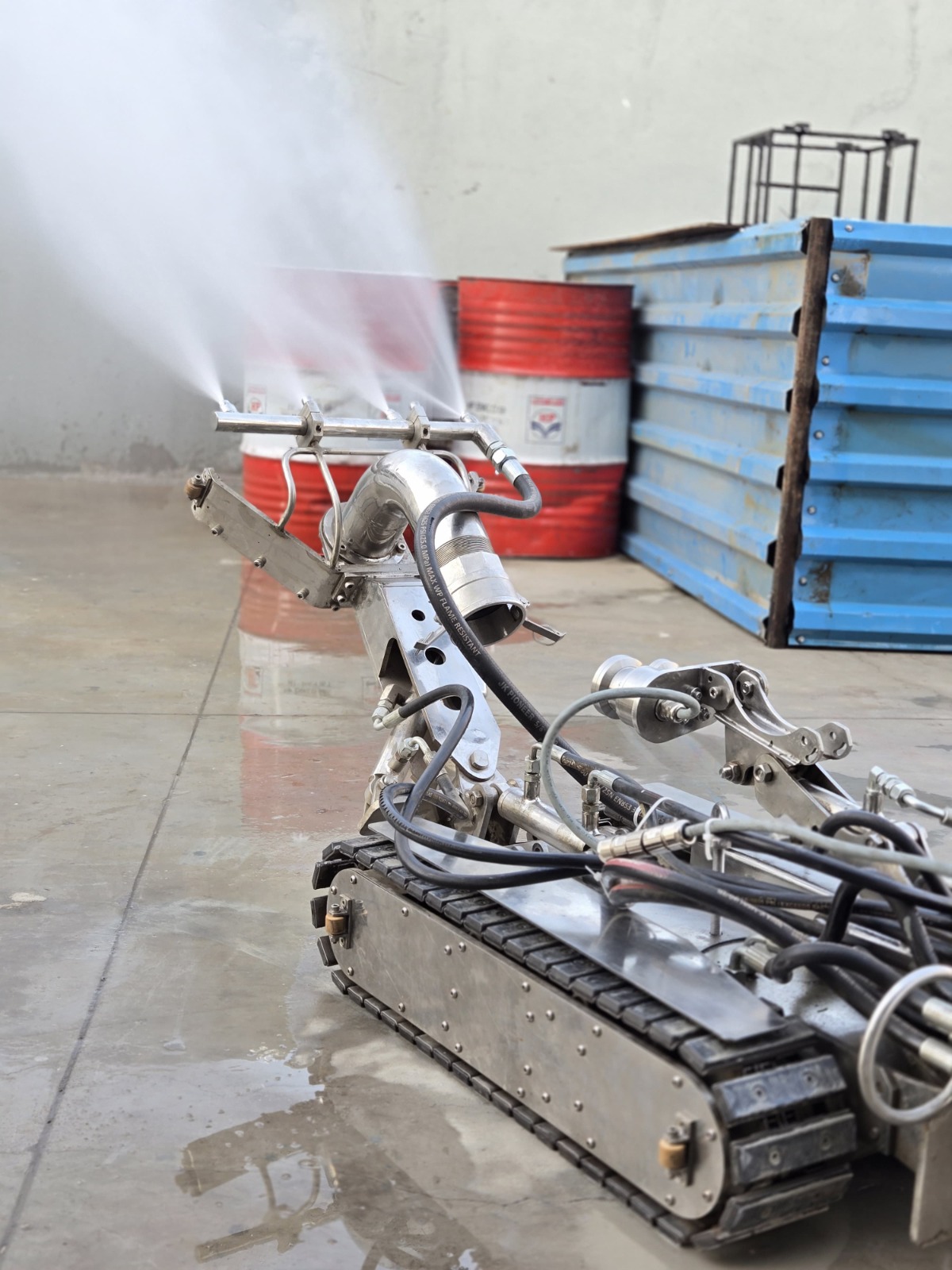
India's industrial sector, spanning petrochemicals, pharmaceuticals, food processing and manufacturing, relies heavily on storage tanks for the containment of various liquids and chemicals. With stringent regulations, safety concerns and operational efficiency becoming paramount, the adoption of advanced cleaning technologies like robotic tank cleaning has emerged as a game-changer in the Indian industrial landscape.
Evolution of robot tank cleaning systems
Traditionally, tank cleaning in India has been a labor-intensive and hazardous task, often involving manual laborers entering confined spaces to perform cleaning operations. This approach poses significant risks to worker safety, leads to prolonged downtime and may result in environmental contamination. Recognizing these challenges, industries are increasingly turning towards robotic solutions to revolutionize their tank cleaning processes.
Robot named MUSHAQ 2.0
Dimensions (L × B × H)
30 × 20 × 8 inches
Hydraulic power pack
15 HP
Jetting pressure
1 to 50 bar
Suction volume
5 to 20 m³ per hour
Maximum range
100 m
Applications
- Storage tank cleaning
- Pipeline cleaning
- Cooling tower sump cleaning
- ETP/OWS pit cleaning
Features & purposes
- Upper nozzles — hitting the sludge mounds
- Lower nozzles — washing the tank bottom surface
- Hydraulic driven, with a hydraulic arm-attached submersible pump
- 3–4 types of augers
- 25 mm solids can be pumped off easily; mechanical agitation mobilises the sludge in lagoons
Arham Oil's robotic tank cleaning solutions
ATEX-certified robots
Designed to operate in hazardous environments, including those with flammable gases and vapors.
Real-time monitoring
Cameras and sensors allow real-time monitoring of the cleaning process, ensuring optimal efficiency and safety.
Customized solutions
Tailored to your specific tank requirements, ensuring maximum effectiveness.
Why choose a tank cleaning robot?
Enhanced safety
Eliminates the need for human workers to enter confined spaces. Operators control the cleaning process remotely.
Efficiency and precision
Advanced sensors allow precise cleaning with minimal downtime, navigating complex tank geometries.
Cost-effectiveness
Reduced labor costs, decreased downtime and enhanced operational efficiency deliver significant long-term savings.
Environmental compliance
Minimizes waste generation and reduces the use of water, chemicals and energy.
Versatility and adaptability
Customizable to different tank sizes, shapes and contaminants across industries.
FAQs
01Is robotic tank cleaning safer than manual methods?
Absolutely. Our ATEX-certified robots eliminate human entry into hazardous environments, removing risks of toxic exposure, explosions or confined-space accidents.
02How much does robotic tank cleaning cost?
Costs vary by tank size and sludge volume, but robotic methods save 40–60% versus manual labor by reducing downtime, waste and labor. We offer flexible Robot-as-a-Service (RaaS) plans with no upfront costs.
03How do your robots clean tanks without human entry?
Our robots use LiDAR 3D mapping to scan sludge and corrosion, precision nozzles for cleaning, and real-time monitoring via live dashboards. Operators control them remotely, ensuring zero human entry.
04Can robotic cleaning handle extreme sludge types (e.g. paraffin, sand)?
Yes. Our robots adjust pressure and suction for paraffin, sand or mixed sludge. Customizable solutions ensure thorough cleaning, regardless of sludge composition.
05How long does the robotic tank cleaning process take?
Typically 3–7 days (vs. 10–14 days manually). Robots work 24/7, and partial tank operations can continue during cleaning, minimizing downtime.